
 Located in the garden of the Kyōto house that I mentioned in the previous post. The light was not fantastic so I turned to the black and white mode on my camera, however I was attracted to how the late afternoon sun struck the geta situated just outside of a sliding glass door leading to a rock garden in the center of the house. The glass in the entire house was original, the leaded variety, warped due to time and environment. Usually reflections are a nuisance, I don't generally take photographs through glass if I can help it, but I like how the distorted glass actually added to the overall atmosphere of the image - the blur and streaks at the top.
Saturday, July 17, 2010
Geta 下駄
Located in the garden of the Kyōto house that I mentioned in the previous post. The light was not fantastic so I turned to the black and white mode on my camera, however I was attracted to how the late afternoon sun struck the geta situated just outside of a sliding glass door leading to a rock garden in the center of the house. The glass in the entire house was original, the leaded variety, warped due to time and environment. Usually reflections are a nuisance, I don't generally take photographs through glass if I can help it, but I like how the distorted glass actually added to the overall atmosphere of the image - the blur and streaks at the top.


Friday, July 16, 2010
Chadōgu 茶道具
 Chadōgu, or tea tools used in the formal Japanese tea ceremony, specifically the Furo 風炉. Furo are portable braziers used in the tea room to heat the hot water kettle (kama) to make the tea. They are commonly made of ceramic or metal - this one is ceramic. Photograph was taken in a Kyōto house that has been turned into a kimono retailer.
Thursday, July 15, 2010
Does Graffiti Bug Ya?
 No they are not real bugs as this weeks theme would suggest. However, these works are insect inspired - I especially like the caterpillar-esque image at the top. While they lack the detail of their living inspirational counterparts, some might still find these depictions creepy in their own right.
Wednesday, July 14, 2010
Terpnosia Vacua

A sure sign that the dog-days of summer are approaching, this is the discarded exoskeleton of a Cicada, Terpnosia Vacua. Immature Cicada nymphs live underground where they suck sap from the roots of trees and shrubs. When they approach maturity, they dig to the surface (hence the clawlike front feet) and molt into winged adults, leaving the exoskeleton behind. In Japan, the cidaca is associated with the summer season and the songs of the cicada are often used in film and television to indicate summer scenes. It is also a pastime for children to collect both cicadas and the shells left behind when molting. Bug collecting in general is popular with little tikes, I often see them dragging their parents through train stations equipped with plastic collection boxes, nets, and other tools for weekend hunts. For the city dwellers the pet shops offer beetles and some other native insects for sale as pets.
Tuesday, July 13, 2010
Tombo とんぼ

I took a picture of a damselfly among sakura blossoms back in March, when they were not a common site. Now many dragonflies and damselflies are darting around areas with still-open water. In Japan dragonflies are symbols of courage, strength, and happiness, and they often appear in art and literature, especially haiku. The Japanese love for dragonflies is reflected by the fact that there are traditional names for almost all of the 200 species of dragonflies found in and around Japan. Japanese children catch large dragonflies as a game, using a hair like thread with a small pebble tied to each end, which they throw into the air. The dragonfly mistakes the pebbles for prey, gets tangled in the hair, and is dragged to the ground by the weight.
Monday, July 12, 2010
The Bee's Knees

A friendly little pollinator I interrupted enjoying a newly blossomed and quite tightly coiled white hibiscus flower. Known as Apis cerana, or mitsubachi in Japanese, they are tiny honey bees that prefer to nest in small spaces (such as hollowed out tree trunks). Like the Western honey bee, they are sometimes domesticated and used in apiculture, mostly in wooden boxes with fixed frames. The mitsubachi are friendly fellows, it is the Japanese Giant Hornet that should be steered well clear of. Actually the mitsubachi have a unique defense against the hornet. Many bees will gather near the entrance of the nest to bait a trap, and as the hornet enters the nest (the hornet feeds on bee larva) a large mob of about five hundred bees surrounds it. Completely covered, the hornet is immobilized and the temperature of this ball-o-bees is so great the hornet dies from heat exhaustion.
Sunday, July 11, 2010
Kogane-Gumo

Saturday, July 10, 2010
Marine Hall
 Marine Hall is one of two wedding chapels located at the Meriken Park Oriental Hotel in Kōbe, the other is located on the astroturf clad roof of the hotel itself. Marine Hall rests alongside the base of the hotel near the water and rather than offering the more common architectural style of Japanese wedding chapels, which are often clad in over-the-top western kitsch suitable only on the sets of Fred Astaire films, the design is based on the form of a seashell. Built in 1995 and designed by the Takenaka Company, it opened just six months after the Hanshin Awaji earthquake. Nearby is the Kobe Maritime Museum and the Kobe Port Tower, which create a nice cluster of interesting architecture.
Friday, July 9, 2010
KEiBuNSHA

Happiness, for me, is instilled by being in the presence of books. Adding art, music, community and charm, might just turn the happiness into pure rapturous delight; and Keibunsha is just that! Stocked with unique books, stationery, art, handcrafts, clothing, music, and interesting zakka (雑貨) enclosed in a charming and nostalgic nook of a building that is illuminated by all fashion of lamps seemly powered by magic as much as electricity. Zakka, for those not familiar with the term, is a fashion and design phenomenon that is embodied by the phrase: seeing the savvy in the ordinary and mundane; which is a phrase that suits the whole store. Meandering through the three rooms with their dark wooden shelves full of all manner of treasures, or visiting the art gallery space at the back of the store is almost like being in another world. Keibunsha is located in Sakyo-ku, a residential area of Kyōto slightly outside from the center of town.
Thursday, July 8, 2010
Tanabata 七夕祭り Matsuri

Separated by the milky way, two star crossed lovers are only able to meet once a year on the seventh day of the seventh month. Thus starts the legend of Hikoboshi (the star Alter) and Orihime (Vega) who is the daughter of Emperor Tentei, and is also a very skilled weaver.
The legend continues, as Orihime sat alongside the the river of heaven (the milky way) she was overcome with sadness due to the fact that she hadn't fallen in love, because she was so busy weaving. The emperor witness her woeful state and arranges a marriage between her and Hikoboshi who lived across the river. The couple was very much in love, however Orihime was neglecting her weaving. Tentei, angered by Orihime's neglect, separates the couple.
Tentei decreed that the couple would only be allowed to see each other on one night each year – on the seventh day of the seventh month. The Tanabata festival (also know as the star festival) celebrates the reuniting of these lovers with sprigs of bamboo, sometimes small and sometimes the size of a tree, decorated with origami and tanzuku (papers with wishes writen on them).
I have been practicing shodo (Japanese calligraphy) for the past 5 months with a very patient and skilled sensei at a community center in Sannomiya. One of the staff at the center requested that I write a banner for the Tanabata Matsuri 七夕祭り and I added some sumi-e to accompany it. Working with ink and brush is rather difficult and unforgiving, but I have seen some improvement over the past weeks.
Wednesday, July 7, 2010
Ōsaka Street Art

Street art from around central Ōsaka and appropriately the Gundam graffiti is from Nipponbashi. Speaking of Gundam the city of Shizuoka, 125 miles west of Tōkyō, has re-erected the statue that was in Odaiba last year - unveiling is on the 24th of July which is also Gundam’s 30th birthday. Shizuoka is the city where most of the Gundam plastic models are manufactured, and even though the location is in the middle of nowhere Bandai (who owns the rights to Gundam) and Shizuoka expect millions of tourists. Unfortunately I cannot justify the expensive trip just to see the statue, especially with little else to see or do in Shizuoka, which makes me a little sad - like the last graffiti.
Tuesday, July 6, 2010
Hall At Nagata Shrine
 The Nagata shrine celebrated its 1800th birthday in 2001 and has a large famous camphor tree located in the Kusumiya Inari shrine on its grounds that is renowned for its divine favor in curing disease. The shrine also features an architectural style called Tsuina Shiki Shinji which became popular in the Muromachi Era. This is a truly peaceful place!
Monday, July 5, 2010
Nagata Jinja 長田神社
 The weather here continues to be a either hot and humid, or rainy and humid, or possibly both at the same time; I suppose in this season if I waited for the weather to be nice enough to venture out of the apartment then I might never leave - and the apartment is way too small to seriously consider that. So I pack up my trusty hand towel (a regular accessory in Japan) and an umbrella and go out exploring, a recent venture brought me to these Ema located in Nagata shrine. Nagata Shrine is rather historical and not terribly far from the apartment. The rain had just stopped for a while and the sun broke through the heavy clouds to highlight this wooden offering. The less than ideal weather does offer the benefit of solitude, all the crowds and tourists generally don't venture far from the covered malls and train stations; which left the shrine still and silent.
Sunday, July 4, 2010
Kōbe Night Cityscape

Cityscape as seen from the Kōbe port with two prominent communication towers, you might recognize one of them from an earlier post. I really like this view it reminds me of the film "Blade Runner" (which was in part visually based on the more densely concentrated Tōkyō cities of Shinjuku and Roppongi) but not quite so dystopian. Hope all you folks in the States have an enjoyable 4th of July.
Saturday, July 3, 2010
TETSUJIN 28-GO

I currently live just down the street from this Super Robot スーパーロボット statue and felt that it was time to revisit it with a new photograph. The last time that I posted about Tetsujin 28-Go (literally Iron Man #28) I was not living in this area and had to make a special trip to see it, but now I pass it quite often. I enjoy seeing all of the tourists, mostly Japanese, coming to visit and take pictures. It attracts people of all ages and it is rare to pass it without seeing someone with a camera or a cell phone camera poised to immortalize the visit. The camera enthusiasts will bring along all their fancy gear (enormous lenses, tripods and bags full of gadgets), while the layperson in content with a picture of themselves or their friends in front of the statue - a kind of 'proof I was here' sort of photograph often taken with the people mimicking the statues posture and gesture. Photograph was taken at F8 for 5 seconds at ASA100 on a very overcast night and at the very end of the exposure I moved the camera ever-so-slightly from side to side to create a mild blur or illusion of movement - which kinda worked.
Friday, July 2, 2010
Sannomiya 三宮 At Night

Downtown Sannomiya near the JR train station on one of the many pedestrian walkways that crossover the busy street below and connects the various train stations and department stores. The nights in Sannomiya are often busy and crowded and this night was no exception. Just a few feet away two fellows had a small audience circled around them as they played an acoustic folk-rock set. It is common to see bands and individuals practicing their craft here and some are quite good - they usually don't accept or expect tips either (though I don't know if this is common throughout Japan). To get this shot I set the camera on the railing, as I was without a tripod, and had trouble keeping the camera still for this six second exposure as the hordes of folks pushed past me - and the walkway was also swaying a bit. The view is not fantastic but to me it seems a bit more interesting with the "time lapse effect" achieved by the longer exposure.
Thursday, July 1, 2010
Mosaic & Kōbe Port

The view across the ocean port near downtown Kōbe is quite popular with tourists and locals alike. On this night, as it is on many summer nights, couples come to take in the 'romantic' view of the twinkling lights and the reflections cast upon the ocean; they sit hand-in-hand with legs gently swinging over the edge of the concrete harbor. Mosaic is the name of the shopping area the rests across the harbor and houses restaurants, bars, a movie theatre, a shopping market, an amusement arcade and a little amusement park. During the day the harbor also hosts buskers and street artists selling calligraphy, open air paintings and crafts. I have found some rather attractive works and wares here and I am sure the street performances are entertaining (if that is your kinda thing) as they do attract large groups of people. However, I have always found buskers a bit creepy and tend to stay clear of them if given the choice. I appreciate the nighttime atmosphere which is quite and still in comparison to the bustling and noise of the daylight hours.
Wednesday, June 30, 2010
The Eye of Sauron Kōbe
 Continuing with the theme of city lights reflected off the low clouds, this is the Kōbe Port Tower and continuing with the geekery {insert Lord of the Rings reference here}.
Tuesday, June 29, 2010
Kōbe Comic Book
 The overcast sky is painted orange by the lights of this communication tower reflecting off the 'low celling' in downtown Kōbe. I especially like how this cityscape looks as if it could have come right out of the pages of a comic book, just {insert Bat-Signal here}.
Monday, June 28, 2010
Ten Million $$$ Dollar View

This week I am going to share some night views of Kōbe from various points. The weather has turned both hot and wet, so my touring about the city is somewhat more comfortable under the cover of night - which brings with it a pungent cooling ocean breeze. This vista of Kōbe and the inland sea comes from atop Mount Maya and is dubbed the "Ten Million Dollar View," and is considered to be one of the top three night views in Japan. Most people visit the top via the ropeway located at Sumadera Station at its base. However, I was feeling particularly adventurous so with light in-hand I headed up in the dark. Besides the ropeway was closed and I had made my way into Suma and did not feel like turing back without seeing the view. The way was rather dark and steep but luckily I did not run across any wild beasties of the four legged or two legged variety. The top was quite and dark and view was beautiful and worth the journey, I had visited this view once before in daylight and I am glad that I knew the way. This particular image is two stacked, one overlooking Kōbe and Ōsaka bay far in the distance and the other on the bottom of the Akashi-Kaikyō Bridge.
Sunday, June 27, 2010
Nipponbashi 日本橋
 While wasps in Japan are large, hopefully they're not quite this gigantic. Nipponbashi, a shopping district in Ōsaka, offers a metallic wasp overlooking the shops - seemingly poised for flight. Known colloquially as "Den-Den Town," Nipponbashi is known for its many shops which specialize in furniture, tools, and "otaku" interests such as electronics, animation, comic books, and collectibles. Here you can find six foot tall Gundam models for sale alongside shops that only sell screws or transistors and there are electronic warehouses full of every type of device known to humankind. The neighborhood is patrolled by socially-awkward-looking fellows thumbing through retro video games or erotic comic books who are totally in their element. Nipponbashi, is often compared to Akihabara in Tōkyō, but unlike Akihabara it hasn't sold itself out to tourists and maid cafes.
Saturday, June 26, 2010
Wildstyle Kansai
 Collection of wildstyle tags and throw-ups from across the Kansai area. Some street artists have a wider geographical rage then I expected. I primarily focus my hunts in Sannomiya and Motomachi near my apartment, however I now recognize the same artists works in Ōsaka, Kyōto, Suma, as well as across Kōbe. These are from either a team or individual named HCP.
Friday, June 25, 2010
Oyamazaki Museum
 Oyamazaki Museum is a former Kyōto villa converted into a museum. The architectural style of the main building, which was completed in 1932, is primarily Tudor Gothic. Architect Tadao Ando designed the dramatic corridor seen here that connects the villa with the underground gallery which he named "the underground jewelry box." This new addition is as much a part of the landscape as it is an exhibition space. In order to avoid overwhelming the existing villa, the tranquil concrete geometric lines of the hall and the cylindrical gallery itself are half buried underground and set close to the existing building so that from the exterior they read more as elements strategically placed to complement the landscape rather set against it. Water-lilies by Claude Monet are exhibited in the annex complimented by the Monet style gardens that surround the building. There is also a circular-shaped skylight which further complements the paintings with natural light that continuously changes and reinvents the paintings.
5-3 Zenihara, Oyamazaki-cho,
Otokuni-gun, Kyoto-fu, 618-0071
Thursday, June 24, 2010
Sushi 寿司

Some time ago some friends treated me to a very nice lunch at the Diamond Kyoto Society that included sushi which is and, for many years now, has been my most treasured cuisine. I appreciate its relative simplicity, texture, taste and esthetic. This meal provided me with a chance to try a new kind of sushi that was topped with tsukimono (pickled vegetables), that proved to be absolutely delicious. Years ago when I was first told that some Japanese rate the quality of sushi on the rice and or the tomago (egg) I was rather confused, I thought the fish was the primary interest of the dish. However, sushi refers to the cooked vinegared rice, that is then commonly topped with other ingredients or put into rolls - so being concerned with the quality of the rice makes sense, though in the states I feel we tend to focus more on the fish. The most traditional form of sushi is fermented fish and rice preserved with salt and this is where the term 'sushi' comes from; being an archaic grammatical form that literally means "it's sour". The contemporary version of sushi was created by Hanaya Yohei at the end of Edo period and is intended to be a finger food prepared and eaten quickly. As for the importance of tamago, it is such a basic component with so few ingredients that if the chef has mastered it, then all of his or her other dishes are sure to be good. Similarly I have heard the best test of any chefs metal can be found through their competence in the most simple dish. So I hope you get to enjoy some sushi soon and I hope that whatever is on top is your #1 favorite.
Wednesday, June 23, 2010
Iris at Nanba Shrine 難波神社
 Located in the heart of downtown Ōsaka near the business district is Nanba shrine, constructed under the reign of Emperor Hanzei, it is now another example of how the Japanese landscape is a mixture of ancient existing right alongside modern. The large stone temple walls enclose the shrine that is otherwise surrounded by modern 20 story office buildings and the endless traffic noise from the busy street right at its gate - a main artery for transportation in the area. The relative silence coupled with the ancient buildings and gardens inside the walls creates an atmosphere that feels almost otherworldly in comparison to the fast moving city just a few feet away. At this time of year the temple also features large groups of potted iris carpeting the interior grounds.
Tuesday, June 22, 2010
JR Namba Station 難波駅
 A rather interesting glass wall with a moving light show in the underground walkway of the JR Namba Station in Ōsaka. This route also features a moving walkway with a fiber-optics displays on the ceiling opposite this glass wall. The lights trace the curved walls on-pace with the commuting hordes who traverse the station. In an attempt to capture this kinetic aspect I lowered the shutter speed and held the camera against my chest and took the photograph while waking, which blurred the lights further down the corridor.
Monday, June 21, 2010
Namba Station Routine
 Teenagers practice a dance routine outside the JR Namba station in Ōsaka, which is actually a fairly common site in Japan. Usually the dancers claim some less crowded corner of the train station or if later in the evening the shopping arcades host a few groups wherever a reflective surface or mirror offers them some feedback of their performance.
Sunday, June 20, 2010
Kuromon Ichiba 黒門市場

Kuromon Ichiba Market, or Black Gate Market, is an enclosed 600 meter market located in the Nippombashi district of Ōsaka. Kuromon has been a marketplace for over 170 years and the vast majority of its stalls specialize in the freshest and highest quality fish, meat, vegetables and fruit. Other stalls feature nearly endless barrels of pickled seaweeds and vegetables, and some household goods. A stroll down this lane is a feast for the eyes as well as a stimulant for the appetite and you are likely to find some unusual edible delight from the sea on display - just try not to become breakfast for the giant ceiling octopus that enacts its swift revenge for its fallen kin.
Saturday, June 19, 2010
Tsūtenkaku 通天閣

Tsūtenkaku (103 m), or Tower Reaching Heaven, is a well-known landmark of Ōsaka. The current tower is actually the second to occupy the site, the original was patterned after the Eiffel Tower - however the government dismantled the tower in 1943 believing that it would serve as a reference point for American bombing raids. In 1956 the current tower was completed and soon became associated with the statue of Billiken, which is a popular symbol of good luck (seen in gold in the right corner). The Billiken was a charm doll created by an American art teacher and illustrator Florence Pretz who is said to have seen the mysterious figure in a dream. Today, the Billiken is also the official mascot of Saint Louis University, Missouri being Pretz's home town.
Friday, June 18, 2010
Kyōto Tower 京都タワー

Designed by Makoto Tanahashi, Kyōto tower is a steel observation tower which is also the tallest structure in Kyōto, with its observation deck at 100 meters (328 ft) and its spire at 131 meters (430 ft). The tower was completed to correspond with the 1964 Summer Olympics in Tokyo and features a unique interior structure that consists of many stacked steel rings covered with lightweight steel sheets, setting it apart from most towers which are lattice frames (such as Tokyo Tower). The tower was designed to resemble a Japanese candle, so the steel sheets were welded together and painted white to create this effect. The Tower has been the subject of controversy since it was in its planning phase, in part because of its hefty price tag but also because many believed the needle-shaped spire was too modern looking for the ancient capital. Some visit Kyōto seeking an elusive sense of old Japan and are surprised by the modern glass and steel station and the neighboring steel tower. Others, including myself, believe they add a touch of modernity to a city otherwise in danger of becoming foreign to the rest of contemporary Japan. View is from an observation deck in Kyōto station overlooking the tower.
Thursday, June 17, 2010
Skyways of Kyōto Eki

The enormity of the engineering challenge necessary to erect Kyōto station is entailed within its giant escalator system, which moves passengers up nine-stories from the 60m high atrium over the main concourse and up to the roof - where there is an expansive view of the city. The structure has a fluidity of space, intriguing discontinuities of scale, open roof lines and a dark futuristic quality. The station building is certainly very imposing and definitively modern in style, setting a stark contrast against the classical feeling of this cultural capital.
Wednesday, June 16, 2010
京都駅 Kyōto-eki

Designed by Hiroshi Hara, this 15-story glass-plated monolith is Kyōto Station. Opened in 1997 to celebrate the anniversary of the foundation of the city as the former capital of Japan it updated and replaced the previous 1950's era concrete station; which was necessary to usher the nearly 50 million tourists Kyōto receives each year - most of them Japanese commuters and visitors on day-trips. It comprises a huge 60 meter tall atrium, measures 470 meters from east to west, with a total floor space of 238,000 square meters. The building includes a department store, the Granvia Hotel, a theater, exhibition space as well as numerous shops and restaurants.
Tuesday, June 15, 2010
Ema 絵馬

Ema are small wooden plaques on which Shinto worshippers write their prayers or wishes. The ema are then left hanging up at the shrine, where the kami (spirits) receive them. Ema come in various shapes and sizes and usually bear pictures, often of animals or other Shinto imagery, representing that particular shrine and also many have the word gan'i (wish) written along the side. These are from Fushimi Inari Taisha so they are understandably in the shape of the kitsune - each person who purchases one draws in the face and inscribes their wish on the back. Common reasons for buying a ema might include success in work or on exams, marital bliss, to have children, and health. Some shrines specialize in certain types of ema and their sales help support the shrine financially.
Monday, June 14, 2010
Fushimi Inari 伏見稲荷大社
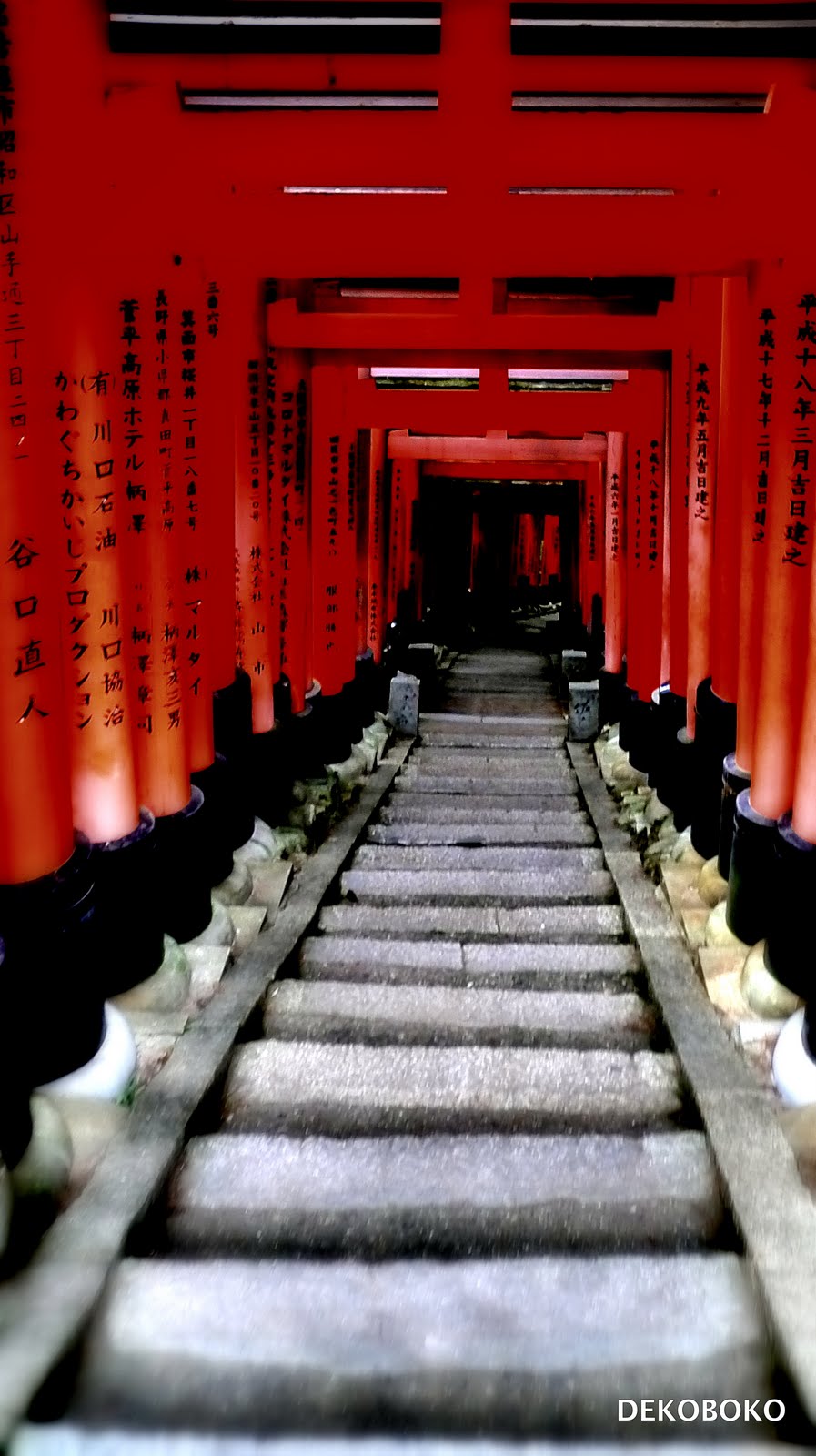
One of Kyoto's oldest (711 BCE) and most revered Shinto shrines, Fushimi Inari Taisha serves as the headquarters for all the 40,000 shrines dedicated to Inari across Japan. While predominantly the deity of rice and sake, Inari has also grown to govern the modern capitalistic concepts of success and prosperity in business and consequently the shrine draws thousands of businesspeople and tradespeople seeking blessings for their enterprises. The many Torii or gates that adorn this mountain shrine are dedicated by prominent families or business and each has the name of the benefactor inscribed upon it.
Sunday, June 13, 2010
Bitter Almond Kit Kat

I have already told you more than you need to know about Japanese junk food, especially Kit Kat, however this new Bitter Almond flavor is worth mentioning. The flavor combination is not exotic, instead it stands strictly on taste not notoriety. According to the box it does have a rather odd cross-promotion with TBC, Tokyo Beauty Clinic, though I'm not sure what Kit Kat has to do with beauty. A great balance of dark bitter but semi-sweet chocolate (44% cacao) and crushed almonds that surrounds the classic Kit Kat wafers with more dark chocolate cream between the wafers.
Incidentally, many crime & punishment stories feature a person who has died unexpectedly having been the victim of cyanide poisoning. The first, best and only symptom of cyanide poisoning in television is that it leaves the smell of bitter almonds on the victim. One interesting thing about this trope is that it is self-reinforcing; the trope itself has raised awareness such that it is increasingly likely that even a layperson would recognize the significance of the smell, but does anyone know what it actually smells like? Well it smells like Bitter Almond Kit Kat . . . tasty and informative.
Incidentally, many crime & punishment stories feature a person who has died unexpectedly having been the victim of cyanide poisoning. The first, best and only symptom of cyanide poisoning in television is that it leaves the smell of bitter almonds on the victim. One interesting thing about this trope is that it is self-reinforcing; the trope itself has raised awareness such that it is increasingly likely that even a layperson would recognize the significance of the smell, but does anyone know what it actually smells like? Well it smells like Bitter Almond Kit Kat . . . tasty and informative.
Saturday, June 12, 2010
もしもし Moshi Moshi

"Moshi moshi" is a greeting used when answering a telephone or trying to get someone's attention, used both by the receiver and the caller. This greeting is uttered an average of 125 million times a day. The term itself apparently stems from Japanese myths of the shape-shifting Youkai, 妖怪 bewitching apparition, which are traditional Japanese monsters of supernatural origin; grotesque, diverse, and often as comical as they are terrifying. Youkai were popular subjects in ukiyo-e prints depicted as oni, tengu, kappa, kitsune and tanuki (the last two are real animals unto which supernatural powers were attributed). The magic behind the phrase "moshi moshi" lies in the Youkai's ability to only say "moshi" once, kinda like the repetitive power of the name Beetlejuice in the Tim Burton film. The weary fellow who answers the single "moshi" called out by a Youkai will have their soul stolen and devoured. Be diligent, add that oh-so-important second 'moshi' to prove you aren’t a soul hungry ghoulie on the other end of that line. Images are Sannomiya graffiti; Oh and it's for you . . .
Friday, June 11, 2010
Kemushi 毛虫 Caterpillar

葉の虫ハ化して飛けり朝の月
Caterpillar transforms
and flies away . . .
morning moon
- Kobayashi Issa
Not able to identify this particular species of caterpillar, it is much easier to find information on butterflies and moths then their respective larval forms. Many caterpillars are cryptically colored and resemble the plants on which they feed and may even have parts that mimic plant parts such as thorns. This caterpillar has long fine hair-like setae with detachable tips for self-defense, some caterpillar even have venom glands associated with these setae or spines. This fellow might look tasty to a bird or another bug, but the coloration and furry texture leave me perfectly content to let it be on its merry way.
Thursday, June 10, 2010
Rice Paddy Field 田

Sunset over a crop of recently planted rice - fields flooded to protect the seedlings from insects and the coming rainy season will keep the fields full of water without the need of further irrigation. Rice can also be grown in dry-fields, but Japan has been using irrigated - wet-rice culture from around the Yayoi era (300 BCE to CE 250) and in the twentieth century paddy field agriculture has became the dominant form of growing rice throughout the world. The acidic soil conditions common in Japan, due to volcanic eruptions, have made the paddy field the most productive farming method. The character 田, which originally meant 'field' in general, is used in Japan exclusively to convey the meaning 'rice paddy field'. Rice consumption in Japan has been steadily falling for the past 40 years, as many rice farmers are increasingly elderly - a fact that is readily apparent to any observer driving through the Japanese countryside. The government has subsidized rice production since the 1970's and is protectionist regarding cheaper imported rice.
Wednesday, June 9, 2010
Kawara Senbei 煎餅

The folks that were kind enough to provide entrance into the Royal Grand Hall of Buddhism also gifted Kawara Senbei in the likeness of the famous onigawara from the Main Hall building. Kawara are roofing tiles made of fired clay and are a type of roof ornamentation found in Japanese architecture. Onigawara are most often found on Buddhist temples, generally manufactured on a style similar to that of kawara but are statue-like depicting Japanese ogre (oni) or a fearsome beast much like a gargoyle. Kawara-senbei, roof tile cookie, are a traditional sweet that has its origins in the Kansai area. This was my first kawara senbei and the flavor was mellow - sweet but not overly so and they have a very pleasing almost smoky flavor. The texture is nice and crispy making for a very delicious treat!
Tuesday, June 8, 2010
Royal Grand Hall of Buddhism - Pagoda

Visible from along the ascending pathway leading to the Main Hall of the Royal Grand Hall of Buddhism and nestled among the richly green trees and foliage of the surrounding mountains is the Five-Story Pagoda, a striking 32.7m wooden structure richly painted in a vibrant and traditional Korean style. Pagodas were originally built to house Buddhist relics and the remains of prominent Monks. On top of the pagoda you can see an antenna like structure. It is a finial or sourin that combines many symbols of Buddhism, it also has the very practical purpose of preventing the pagoda from leaking where all the roof elements are joined and also functions as a lightning rod.
Monday, June 7, 2010
Royal Grand Hall of Buddhism - Main Hall

Nestled in a valley in Kato City, the Royal Grand Hall of Buddhism is a sprawling architectural splendor measuring 148ha or 366 acres. I recently had the rare chance to tour this complex touted as the largest Buddhist temple edifice in the world; the many modern temples within its grounds utilize traditional architecture and took nearly half a century of endeavor to complete. The imposing Main Hall atop the slope is adorned with 10,450 carvings and 320,000 gold chasings, and in the center sits the gilded Golden Shrine. At 51.5m in height (equivalent to an 18-story building), the Main Hall is the largest temple in Japan. Outside, in the temple grounds, the extensively landscaped gardens are laboriously kept immaculate - more natural than nature - and are dotted with rare species of trees including the 800-year-old podocarpus tree. The complex is the vision of Dr Kyuse Enshinjoh and 82 priests of the Nenbutsushu Buddhist sect, one of 60 Buddhist sects in Japan, who imagined building a temple that would serve as the spiritual center for the 370 million Buddhists in the world. The Royal Grand Hall of Buddhism was built at a cost of 60 billion yen.
“Such a grand-scale Buddhist temple has never been built in the history of Japan since the erection of the main temple of Obakushu Buddhist sect in Kyoto 350 years ago,”
-Shinku Miyagawa (Nenbutsushu High Priest).
It is the founders hope that the center will serve as a meeting place for the Buddhist leaders of the world to overcome any differences in nationalities or traditions and unite them.
Royal Grand Hall of Buddhism - Lanters

A pair of guardian deities on either side of the Main Gate urge people to do good and refrain from evil, these lacquered statues are the largest of their kind in the world. The one on the right has its mouth open - symbolizing un (breathing in), while the other has its mouth closed -symbolizing ah (breathing out). The pair of huge stone lanterns (12m in height) in front of the Main Hall, made their way into the Guinness World Records as the largest stone lanterns. The temple also has the largest onigawara (ridge-end tile) stretching 9m in height and 8.8m wide, installed on the roof-top of the main temple building. Final image is of the very informative monk who guided our small group through the complex; he like many buddhist who carry o-juzu 御数珠, or counting beads, use this traditional tool to count time while meditating using mantras even while holding conversations or guiding tours. Most of the people who go to this complex are on a pilgrimage and entrance into the complex is kept rather official with forms and badges required. The presence of security is also felt throughout the complex and, aside from the monk, our group was also flanked by 4-5 other assistants/guides/guards - difficult to tell what purpose they ultimately served. The site being almost encased in the eight surrounding mountain ranges coupled with its imposing gates, security, wealth and quietly powerful presence give the complex an imposing if not holy atmosphere.
Royal Grand Hall of Buddhism - Main Gate
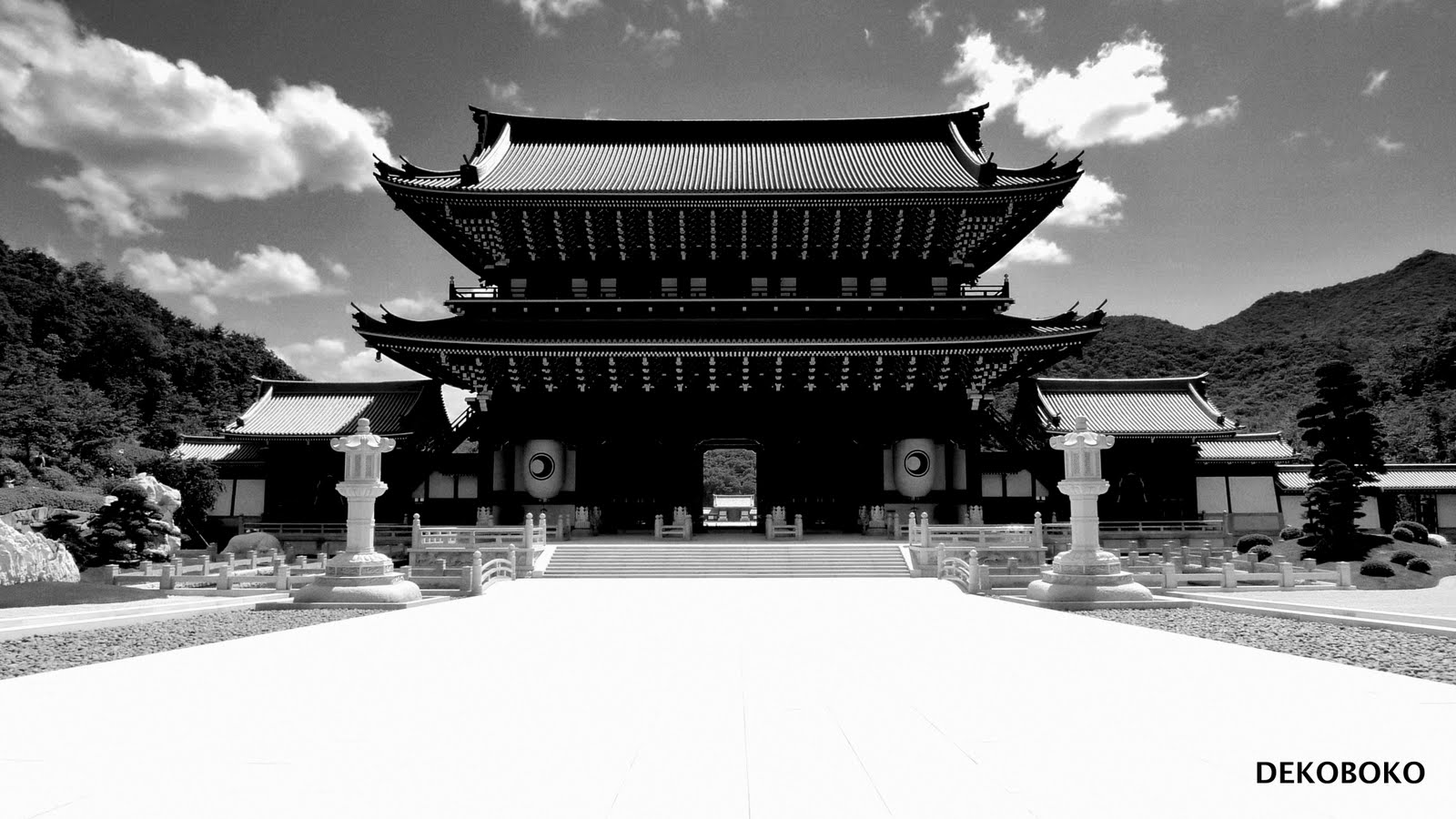
The 141m-long Tathata Bridge crosses over Moonlight Pond which leads visitors to the main gate (35.6m high and 34.5m wide), seen here from behind and already having passed through an impressive front gate with heavy fortified doors just visible through the doorway of this image.
Sunday, June 6, 2010
Nunobiki Falls - Medaki

In Japan, Nunobiki is considered one of the great"divine falls" along with the Kegon Falls in Nikko and the Nachi Falls in southern Wakayama. A well-known section of the Tales of Ise describes a trip taken to the falls where a poem by Ariwara no Narihira is quoted – inscribed on a monument near the falls:
White cascading gems
scatter down
as if someone has unstrung a necklace
I desire to hold them all,
Alas, my sleeves are too narrow
There are actually two falls that make up Nunobiki, the Medaki (Female Falls) and the larger Odaki (Male Falls) higher up the mountain. Aside from poetry the falls are also the subject of legends and tales, including the two falls being considered as male and female deities with all the ensuing romance and drama. Upon revisiting this area I found that what I previously believed was the largest of the falls is actually the smaller, the Odaki was higher up the mountain and the area truthfully contains four waterfalls - the last two being considerably smaller - hence my previous confusion.
Nunobiki Falls - Odaki

Nunobiki means “cloth-pulling” and the falls inspired some poets to liken the strands of white-water to cloth being stretched to bleach, producing a dress for the mountain goddess. Other poets write of clouds on the mountain slope which on closer inspection proved to be the thundering waterfall. One sentimental poet was driven to pen an association between the countless water-drops and his own tears.
Which, I wonder, is higher-
This waterfall or the fall of my tears
As I wait in vain,
Hoping today or tomorrow
To rise in the world.
Saturday, June 5, 2010
Tokusatsu or The Return of Kamen Rider Cider

The Kamen Rider series of ciders taps the nostalgia of retro pop culture alongside the recent resurrection in popularity of Japanese cider that presents an 'old hometown' taste. Cider, in this context, refers to a clear Japanese carbonated soft drink created in the late 1800's with a tart citrus flavor. I spotted my first can back in March and recently on a late night coin-based-convenience binge decided to get another. Tokusatsu, literally special effects, is a Japanese term that applies to any live-action film or television drama that usually features superheroes and makes considerable use of people in rubber monster costumes. The most popular types of tokusatsu are kaiju monster movies like Godzilla, superhero TV serials like Kamen Rider and Metal Hero Series like Himitsu Sentai Goranger (Power Rangers). Tokusatsu remains a popular form of entertainment in Japan inspiring a rabid fan-base that, alongside anime, has spawned all manner of toys, collectibles, fans and cosplay. The cider itself is quite tasty and refreshing, but sadly it is non-alcoholic, it can be a bit heavy on the sugar - one can really satisfies the sweet-tooth.
Friday, June 4, 2010
Shinkawa Canal Floodgate

Floodgate at the branch point of Shinkawa river from Hyogo canal. The Hyogo canal is the largest canal in Japan and was excavated to make a water way that links the Suma area to the Hyogo Port without having to take a roundabout route that passes through the treacherous Cape Wada.
Thursday, June 3, 2010

Wednesday, June 2, 2010
At The Foot of Hyogo Daibutsu

"I see rising out of darkness, a lotus in a vase. Most of the vase is invisible; but I know that it is bronze, and that its glimpsing handles are bodies of dragons. Only the lotus is fully illuminated: three pure white flowers, and five great leaves of gold and green, an artificial lotus. The reason that I see the lotus, one memory of my first visit to a Buddhist sanctuary, is that there has come to me an odor of incense. Often when I smell incense, this vision defines; and usually thereafter other sensations of my first day in Japan revive in swift succession with almost pain acuteness."
- Lafcadio Hearn (Koizumi Yakumo 小泉八雲)
Tuesday, June 1, 2010
兵庫大仏 Hyogo Daibutsu
 Bronze Hyogo Daibutsu at Nofuku-ji in Kōbe. Although Nofuku-ji suffered extensive damage during the Hanshin-Awaji Earthquake and underwent drastic repairs, the Buddha was not disturbed. The original bronze Daibutsu was put in place in 1891, sadly it was melted down during WWII to make weapons and the present statue was cast in 1991. The bronze has developed the smoky green patina that comes from exposure to the idiosyncrasies of ocean air and stands 18 meters (on a 10 meter pedestal) weighing 60 tons, making it one of the largest in Japan. The more celebrated Kamakura Buddha and the Nara Buddha are only centimeters taller and while they are also impressive they are also quite remote and difficult to access. The location and the steps leading up to the lotus flower where the Buddha sits makes the Hyogo Buddha very approachable and on weekdays the temple is virtually empty. I had some trouble finding it at first, but eventually while I was wandering around I looked-up to see this large curious head just peering over the nearby houses, buildings and walls. I was surprised to find him actually sitting in somewhat unceremonious surroundings common in the semi-urban/industrial area of modern Hyogo but ultimately this contrast serves the statue, accentuating its impressive size and beauty.
Subscribe to:
Posts (Atom)


 Posts
Posts


